
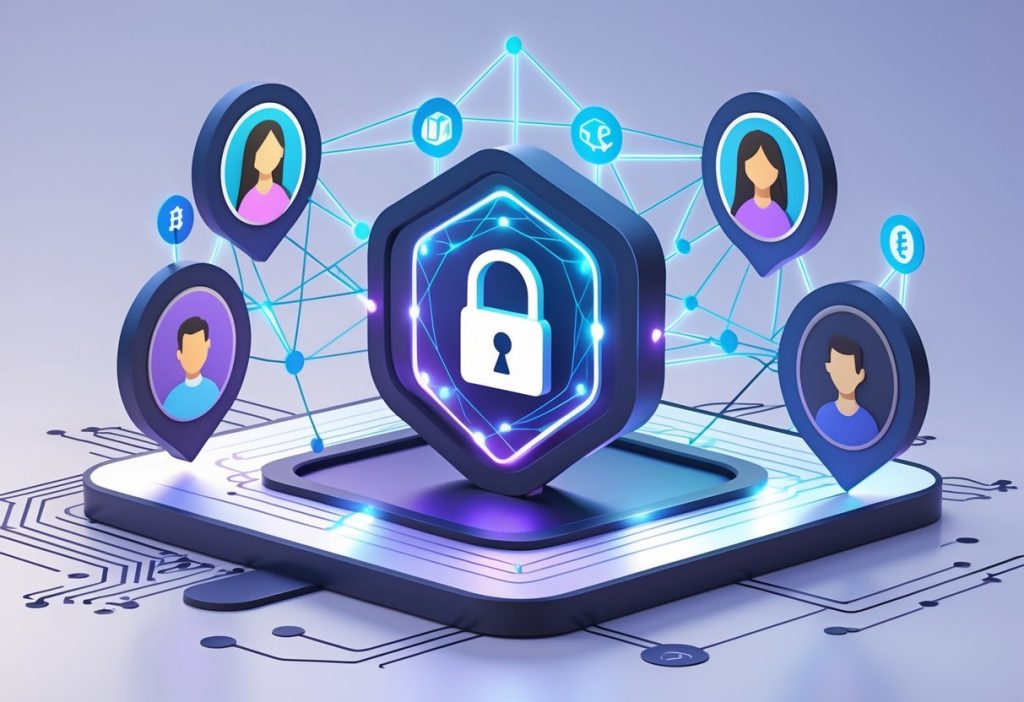
Core Principles of Web3 Social & Decentralized Identity
Web3 changes digital identity by giving users control of their personal information through cryptographic keys and blockchain. Instead of companies storing user data, individuals keep credentials in digital wallets and choose what to share and when.
How Web3 Changes Digital Identity
Web3 identity replaces platform-controlled usernames and passwords with wallet addresses that serve as digital identifiers across many services.
These wallet addresses link to credentials, achievements, and digital assets that build a user’s online reputation. For example, someone might prove they completed a gaming tournament or verified their age without revealing their birthdate.
The system works without a single company managing the data. Blockchain networks record identity transactions transparently while keeping personal details private. Users can log into different platforms using the same wallet, carrying their reputation and credentials wherever they go.
This approach eliminates the need to create separate accounts for each service. Players maintain one identity they control, not dozens of profiles scattered across different companies’ databases.
Decentralized Identity vs. Traditional Models
Traditional identity systems store personal information on company servers that become targets for hackers. One data breach can expose millions of user records at once.
Decentralized systems distribute identity data differently. Users keep credentials in encrypted wallets on their own devices. Companies never store the actual personal information—they only verify credentials when users choose to share them.
Key Differences:
| Traditional Identity | Decentralized Identity |
| Company controls data | User controls data |
| Stored on central servers | Stored in user’s wallet |
| Single point of failure | No central target |
| Company decides access | User grants permission |
| Limited portability | Works across platforms |
Traditional systems force users to trust that companies protect their data properly. Decentralized models remove that trust requirement through cryptographic verification.
Self-Sovereign Identity Explained
Self-sovereign identity means individuals own and control their digital credentials completely. No government, company, or third party can take away or modify someone’s identity without their permission.
This concept relies on three elements. First, users generate cryptographic key pairs that prove ownership. Second, credentials get issued by trusted parties but stay with the user. Third, verification happens through cryptography rather than a central database.
A practical example: someone proves they’re over 18 to access a casino platform without revealing their exact age. The credential issuer signs the age verification, and the user presents this proof when needed while keeping other details private.
Self-sovereign identity puts individuals in charge of when, how, and with whom they share information. This privacy-first approach aligns with Web3’s broader goals of user empowerment and data ownership.
Key Technologies Enabling User Control
Web3 social platforms and decentralized identity systems use three main technologies to give users control: blockchain networks, digital wallets, and verifiable credentials. Blockchain creates permanent, tamper-proof records. Digital wallets store encrypted credentials. Verifiable credentials let users share specific information without exposing everything.
Blockchain as the Foundation
Blockchain technology is the base layer for decentralized identity. When a user creates a decentralized identity, the blockchain stores a unique identifier and public keys for verification. This information lives on distributed networks like Ethereum, so no platform can delete or change it without permission.
Companies currently store user data on private servers and control access. Blockchain lets users anchor their identity to a network that operates independently of any single platform.
Smart contracts add programmable rules to identity systems. They automatically execute actions when conditions are met, like granting content access or verifying age. Users stay in control because these contracts run on public blockchains that anyone can audit.
Digital Wallets and Decentralized Identifiers (DIDs)
Digital wallets securely store identity information that users control directly. Unlike password-protected accounts managed by companies, crypto wallets use private keys owned only by the user. These wallets store DIDs—unique identifiers that work across different platforms and services.
A DID is a string of characters (like did:example:123456789) that connects to a document with public keys and service endpoints. Users create these identifiers without needing permission from any authority. The wallet software handles the technical details while users simply approve or deny requests to share information.
Self-sovereign identity relies on this wallet-based approach. Users can log into Web3 social platforms, prove credentials, and sign transactions without creating traditional accounts. The wallet becomes a universal identity tool that travels with users across the decentralized web. Services like Ethereum Name Service (ENS) make this easier by turning complex addresses into readable names like “alice.eth.”
Verifiable Credentials and Security Layers
Verifiable credentials work like digital certificates that prove specific claims about identity. A university might issue a credential confirming graduation, or an age verification service might confirm someone is over 18. These credentials are cryptographically signed by the issuer and stored in user wallets.
The power lies in selective disclosure. Users can prove they meet requirements without revealing unnecessary information. Zero-knowledge proofs make this possible by letting users verify claims without exposing the underlying data. For example, someone proves they’re old enough to access content without showing their exact birthdate.
Key credential components:
- Issuer signature: Cryptographic proof of who created the credential
- Expiration data: Time limits that maintain credential freshness
- Subject claims: Specific attributes being verified
- Proof format: Mathematical evidence that validates claims
Security layers protect these credentials through encryption and multi-signature requirements. Users can revoke credentials if wallets get compromised, and issuers can update or invalidate credentials as needed. This creates a trust framework where verification happens instantly without storing sensitive data on central servers.
Web3 Social Platforms: Identity Ownership & Rewards
Web3 social platforms use blockchain to give users control, letting people own their profiles as digital assets and earn rewards for their activity. Instead of platforms holding all the data, users control their identity through wallets and can take it anywhere they want.
User-Owned Profiles and Accounts
Traditional social media keeps profiles locked inside company servers. If an account gets banned or a platform shuts down, everything disappears. Web3 changes this by storing profiles on blockchain as NFTs or through decentralized identifiers (DIDs).
Lens Protocol is a good example. Each profile is an NFT that users own in their wallet. The platform cannot delete it or take it away. All posts, followers, and content link to this NFT profile. If someone stops using one app built on Lens, they can move to another app and keep everything.
ENS (Ethereum Name Service) works differently but serves the same goal. Users get a human-readable name like “player.eth” instead of a long wallet address. This name becomes their portable username across Web3. It replaces the email and password system completely.
Ownership means freedom. Users decide where their profile lives and how it gets used. They also protect themselves from sudden bans or data loss. The identity belongs to the person, not the company running the app.
Tokens, NFTs, and Incentivized Engagement
Web3 platforms reward users with tokens for creating content, commenting, and engaging. This flips the old model where only the platform made money from user activity.
Steemit was one of the first to do this. Writers earn STEEM tokens when others upvote their posts. The more engagement a post gets, the more tokens the creator receives. These tokens can be traded or converted to real money.
Many newer platforms use similar systems. Some give tokens for posting photos or videos. Others reward users for moderating communities or finding bugs. The idea is simple: if users create value, they should get paid for it.
NFTs add another layer. Creators can mint their posts as NFTs and sell them directly to fans. Profile pictures, posts, and even usernames can become tradable assets. This creates new income streams without relying on ads or platform cuts.
| Platform | Reward Type | How Users Earn |
| Lens Protocol | Social tokens | Engagement and content creation |
| Steemit | STEEM tokens | Upvotes on posts |
| DeSo | DESO tokens | Creating and curating content |
Cross-Platform Identity Portability
One major advantage of decentralized identity is portability. Users carry their profile across multiple apps without starting over each time.
Farcaster and CyberConnect both focus on this concept. A user creates one identity and uses it on any app that supports the protocol. Followers, reputation, and history move with them. This breaks the walled gardens that Web2 platforms built.
In Web2, switching from one social network to another means losing everything. Followers stay behind. Posts disappear. Web3 fixes this by storing social connections on blockchain. The data travels with the user, not the platform.
This portability also helps creators build stronger brands. They do not depend on one company’s rules or algorithm changes. If a platform becomes unfair or unpopular, creators move elsewhere without losing their audience.
Decentralized identity also reduces the need to share personal information repeatedly. Users log in with their wallet or DID and keep control over what data gets shared. Privacy improves while convenience increases.
Adoption, Challenges, and Compliance in Crypto Gaming
Web3 gaming faces three main obstacles as it moves toward mainstream adoption. Players want privacy and fairness, regulators require transparency, and platforms must deliver smooth user experiences at scale.
Privacy, Trust, and Fair Play for Players
Players in Web3 games want control over their data and in-game assets. Traditional gaming models store everything on company servers, but blockchain-based games let players truly own their items.
The problem is bot farms and fake accounts. In summer 2025, a 30,000-phone operation in Vietnam gamed crypto airdrops, stealing rewards from real players. Anonymous wallets made this possible.
Decentralized identity solves this without exposing personal information. Players can prove they’re unique humans through cryptographic verification. No real names required. No centralized databases to hack.
This technology enables:
- Fair airdrops where each real person gets one share
- Bot-resistant gameplay that protects competitive integrity
- Portable reputation that travels across different games and platforms
Players maintain privacy while platforms gain the tools to stop cheaters.
Regulatory Pressures and KYC in Decentralized Contexts
Regulators are tightening rules around crypto gaming. The EU’s MiCA regulation went into full effect in 2025, requiring exchanges and asset providers to verify user identities by late 2025.
Gaming platforms that handle valuable digital assets face similar scrutiny. They must confirm user ages, locations, and identities without becoming surveillance systems. The challenge is meeting these legal requirements while preserving the privacy that attracted players to Web3 in the first place.
Decentralized identity offers a middle path. Players can prove specific facts—like being over 18 or residing in an allowed region—without revealing everything else. These proofs work through zero-knowledge cryptography, confirming truth without exposing data.
No central database stores sensitive information. Players control what they share and when.
Scalability and User Experience
Web3 gaming needs to be as smooth as traditional games to attract mainstream players. Most gamers don’t want to manage private keys or learn blockchain technology.
Current pain points include:
- Slow transaction speeds during peak gameplay
- High gas fees that make small purchases impractical
- Complex wallet setups that confuse new users
Identity systems add more complexity. If verification takes too long or involves too many steps, players will leave.
Infrastructure improvements are needed. Layer-2 networks make transactions faster and cheaper. Better wallet designs hide blockchain details behind familiar interfaces. Decentralized identity protocols that integrate smoothly make verification easy for users.
Frequently Asked Questions
How does decentralized identity enhance user privacy and control in Web3 social platforms?
Decentralized identity gives users control of their personal information. Instead of platforms storing data on central servers, individuals keep credentials in digital wallets only they can access.
Users decide what information to share and when. For example, someone can prove they’re over 18 without revealing their birthdate. They can verify their location without exposing their address.
This approach means platforms don’t need to collect or store large amounts of user data. No central database means no single target for hackers. Each user manages their own digital identity.
Web3 social platforms built on decentralized identity can’t sell user data to advertisers or change privacy policies to access information users never agreed to share.
What are the security benefits of using decentralized identities over traditional login methods?
Traditional login systems are vulnerable because they’re centralized. When a platform is hacked, millions of usernames and passwords can leak. Decentralized identities remove this risk.
Cryptographic signatures verify each interaction without exposing private keys. These signatures prove identity without using passwords that can be stolen or phished.
Users authenticate through digital wallets using private keys that never leave their devices. Even if a platform is compromised, attackers can’t access user credentials because the platform never stored them.
Decentralized systems also prevent attacks like credential stuffing. Since users don’t reuse passwords across platforms, a breach on one site can’t affect accounts elsewhere.
Can you explain how decentralized identity works with blockchain to manage digital reputations?
Blockchain networks store Decentralized Identifiers linked to public verification information. These identifiers are permanent and can’t be changed or deleted by others. The user who created the DID controls it.
Verifiable credentials are signed by issuers and stored in user wallets. For example, a university can issue a diploma credential on-chain. An employer can verify it instantly without contacting the university.
Reputation builds through verifiable credentials and on-chain activity. Actions like content creation, community participation, and achievements create a tamper-proof history that follows users across Web3 platforms.
Smart contracts can automatically verify credentials and grant access based on reputation. A DAO might require specific credentials for voting rights. A platform might offer features only to users with verified contributions.
What steps should you take to secure your decentralized identity on Web3 platforms?
Users must protect their private keys. These keys control decentralized identities and any linked assets. Losing a private key means losing access permanently with no recovery.
Hardware wallets provide strong protection for private keys. These devices keep keys offline and require physical confirmation for transactions, protecting against malware and remote attacks.
Private keys should be encrypted before storing backups. Strong passwords and encryption methods like AES-256 add security. Never store keys in plain text files or unencrypted cloud storage.
Enable multi-factor authentication when possible. Extra verification steps add security even if one method is compromised.
Regular security audits help find vulnerabilities. Users should review which platforms can access their credentials and revoke permissions for services they no longer use.
Could you detail the interoperability of decentralized identities across different Web3 ecosystems?
Decentralized identities work across platforms and blockchains using standardized protocols. The W3C Verifiable Credentials standard lets credentials issued on one platform be verified anywhere that supports the standard.
Different DID methods meet different needs while staying compatible. The ethr method works with Ethereum-based platforms. The web method integrates with traditional internet infrastructure. Users can choose methods that fit their needs.
Cross-chain bridges and universal resolvers enable identity verification across blockchain networks. A credential from Ethereum can be verified by applications on Polygon or other compatible chains.
Users carry their identity profile between platforms without creating new accounts. Credentials earned on one social network remain valid on another. Reputation and achievements transfer easily.
This interoperability breaks down the barriers of traditional social media. Users own their social graphs, content, and reputation, independent of any single platform.
What are the potential impacts of decentralized social networks on online community building?
Decentralized social networks shift power from platforms to communities. Users can’t get permanently banned from the entire ecosystem because no central authority controls access. Communities set their own moderation rules.
Content creators own their work and audience relationships directly. Platform changes or shutdowns can’t destroy years of community building. Followers and content remain accessible regardless of corporate decisions.
Token-based governance lets community members vote on features, policies, and resource allocation. This helps platforms focus on user needs instead of shareholder interests.
Economic models change with decentralized identity. Creators get paid directly through crypto payments without platform fees. Users can choose when to share their data with advertisers and earn money for it.
Community reputation systems become portable and verifiable. Trusted members keep their standing across different groups and platforms.