
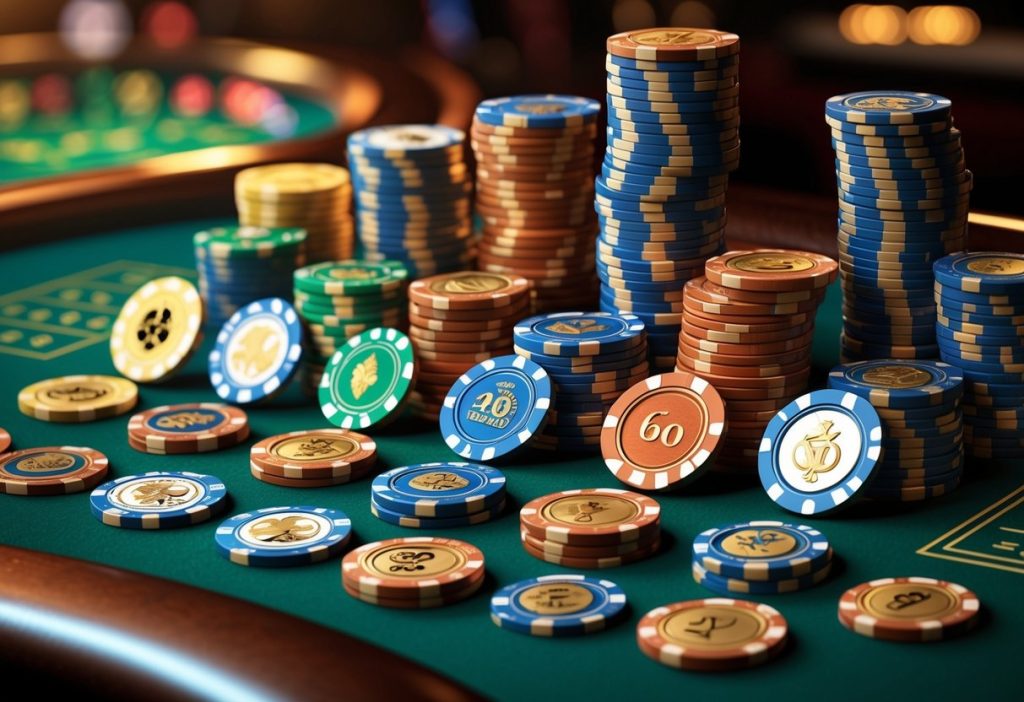
What Are Casino Tokens & Betting Coins?
Casino tokens and betting coins are blockchain-based digital assets made for online gambling platforms. These tokens offer benefits like staking rewards, lower fees, and exclusive game access that standard cryptocurrencies do not provide.
Key Features and Types
Casino tokens run on major blockchain networks such as Ethereum, BNB Chain, and Solana. Players can get these tokens by buying them on crypto exchanges or earning them through gameplay on the platform.
Common token types include:
- Utility tokens – Used for bets and accessing features
- Staking tokens – Let holders earn passive rewards
- Governance tokens – Give voting rights on platform decisions
- Profit-sharing tokens – Share casino revenue with holders
Many gambling tokens have deflationary mechanics like buyback-and-burn programs. Rollbit Coin (RLB) leads this trend, having removed over half its supply through hourly burns. This reduces the total supply over time, which can increase value for holders.
Players benefit from faster transactions and lower fees compared to Bitcoin or Ethereum. Tokens built on the same blockchain as the casino often process instantly with minimal cost.
Casino Coins Versus Traditional Chips
Traditional casino chips exist only inside one physical or online casino. Players buy chips with real money, use them for gaming, and cash them out at the same venue.
Casino coins work differently. These blockchain assets can be traded on crypto exchanges, moved between wallets, and sometimes used across several platforms. Players own their coins and control them with private keys.
Key differences:
| Feature | Traditional Chips | Casino Coins |
| Ownership | Casino holds value | Player owns tokens |
| Portability | Single platform only | Tradeable on exchanges |
| Value | Fixed to fiat currency | Market-driven price |
| Earning potential | None outside gambling | Staking rewards available |
Casino coins also provide extra earning opportunities. Many platforms offer staking programs where holders earn daily payouts for keeping tokens in their account. BFG Coin from BetFury operates a daily drop system for all token holders.
Role of Gambling Tokens in Online Casinos
Gambling tokens connect players directly to casino economics. Platforms use these tokens to build communities and reward loyal users.
Token holders often get VIP treatment, such as access to exclusive tournaments, special games, and priority support. Some casinos give holders voting rights to influence platform development.
Staking is the most popular use. Players lock their tokens to earn passive income while gambling. Rewards come from casino revenue, creating a profit-sharing model.
Casinos also use tokens to lower operational costs. Processing payments in native tokens costs less than using multiple cryptocurrencies or fiat. These savings are passed to players through lower fees and better odds.
SHFL token from Shuffle Casino is the second-largest gambling token by market value and offers staking rewards, airdrops, and VIP perks to holders.
How Casino Tokens & Betting Coins Work
Casino tokens and betting coins operate on blockchain networks that record all transactions in a public ledger. This enables faster payments, lower fees, and removes the need for traditional banking.
Blockchain Technology and Security
Blockchain networks create a permanent record of all transactions. Each time a player deposits, bets, or withdraws casino coins, the blockchain logs that activity across multiple computers instead of a central database.
This setup makes gambling tokens harder to counterfeit or manipulate. Players can check their balances and betting history at any time because the information is public. Casino operators benefit as blockchain eliminates chargebacks and reduces payment fraud.
Most casino coins run on networks like Ethereum, BNB Chain, or Solana. All use cryptographic methods to protect user funds. Players hold tokens in digital wallets that require private keys for access, adding protection.
Smart Contracts in Gambling
Smart contracts are programs that run automatically when conditions are met. For casino tokens, these contracts handle game outcomes, payouts, and bonus distributions without human help.
When a player bets using gambling tokens, a smart contract processes the wager and determines the result based on coded rules. Payouts happen instantly if the player wins. This creates “provably fair” gaming, where players can check the code to verify fairness.
Platforms like Fairspin and BC.Game use smart contracts to manage token reward systems. Players earn casino coins through gameplay, and the contract automatically calculates and distributes rewards based on betting volume or participation.
Transaction Speed and Costs
Traditional casino payments through banks or cards can take days and often include fees of 2% to 5%. Casino tokens remove most of these delays and costs.
Blockchain transactions usually complete within minutes, though speed depends on the network. Solana-based gambling tokens often process in seconds, while Ethereum transactions might take a few minutes. Players avoid long withdrawal waits common in traditional online casinos.
Transaction fees for casino coins are much lower than conventional methods. Depending on the network, fees range from a few cents to a couple of dollars per transaction. This makes gambling tokens practical even for small bets and withdrawals.
Leading Casino Tokens & Betting Coins
The casino token space includes revenue-sharing assets, platform coins, and infrastructure tokens that power on-chain betting. Market cap leaders often have deflationary mechanics, while newer projects focus on partnerships and gaming features.
Popular Gambling Tokens and Their Use Cases
Rollbit Coin (RLB) stands out with its hourly buyback-and-burn model tied to casino revenue. The platform has removed over half its original supply, creating scarcity as trading and betting volumes grow. Players use RLB for cashback bonuses and lottery entries.
Shuffle (SHFL) builds casino infrastructure that other platforms can use. Weekly burns tied to partner revenue support the token’s deflationary design. Growth depends on how many casinos integrate the system.
BFG Token powers BetFury’s loyalty program. Players stake BFG to earn passive income from platform profits distributed daily. The token also unlocks VIP tiers and rakeback deals. Regular burn events reduce supply based on casino earnings.
WINR Protocol provides liquidity pools and game logic for decentralized betting apps. Developers use WINR to build provably fair games without running their own casino. The token rewards liquidity providers who back the house edge.
Most Traded Casino Coins by Market Capitalization
| Token | Market Cap | Primary Use |
| Rollbit Coin (RLB) | ~$147M | Casino rewards & burns |
| Shuffle (SHFL) | ~$122M | Infrastructure & partner burns |
| BFG Token | ~$16M | Staking & profit sharing |
| WINR Protocol | ~$7.3M | Liquidity & game building |
These four tokens dominate trading volume in the gambling category. RLB and SHFL hold the top spots with deep liquidity on major exchanges. Smaller caps like BFG and WINR trade mostly on DEXs and niche venues.
Market cap is price times circulating supply, but it does not show everything. Thin float can inflate rankings. Upcoming token unlocks can flood the market. Always check trading volume and order book depth before buying.
BC Game Token: Platform and Features
BC Game is a multi-chain casino supporting Bitcoin, Ethereum, and many altcoins. The platform offers slots, live dealers, sports betting, and a native lottery. Over 10,000 games are available from providers like Pragmatic Play and Evolution Gaming.
BC Game’s reward system uses a points-based VIP program. Players earn points through wagers, unlocking higher rakeback percentages and exclusive bonuses. Withdrawals process in minutes for most cryptocurrencies.
The platform runs regular promotions like deposit bonuses, rain events in chat, and community challenges. Security features include two-factor authentication and cold wallet storage for most player funds. BC Game holds a Curaçao license and publishes monthly RTP reports.
Ecosystem Partnerships and Integration
Major casino tokens integrate with DeFi protocols for extra utility. RLB appears on Uniswap and centralized exchanges, giving holders exit liquidity. SHFL partners with multiple casinos to expand burn mechanics.
Cross-chain bridges let players move tokens between networks. Solcasino Token (SCS) operates on Solana for fast settlement and low fees. Users bridge assets from Ethereum or Polygon to access the casino without slow confirmations.
Payment processors like Transak and MoonPay enable direct fiat-to-token purchases inside casino dashboards. This helps new players who do not hold crypto. Wallet providers like MetaMask and Trust Wallet streamline deposits.
NFT integrations add another layer. Some platforms issue NFTs that boost rewards or grant tournament access. TG Casino combines Telegram bots with token rewards, letting players bet directly in chat rooms. These partnerships push tokens into daily use beyond speculation.
Navigating Casino Tokens: Regulations, Risks, and Best Practices
Casino operators face strict legal requirements around token management, while players need to understand security protocols and make informed choices about which platforms offer legitimate gaming coins. Digital tokens and blockchain-based systems add new layers of both opportunity and complexity to traditional chip tracking methods.
Legal and Regulatory Considerations
Casinos must comply with the Bank Secrecy Act and anti-money laundering (AML) regulations when managing tokens. These laws require operators to monitor chip movements, verify player identities, and report suspicious transactions. Traditional casinos track physical chips through surveillance systems and RFID technology embedded in high-value tokens.
Digital casino tokens face extra scrutiny. Regulators distinguish between social gaming tokens with no cash value and real-money gaming coins that players can redeem. Platforms offering blockchain-based tokens must navigate licensing requirements that vary by jurisdiction.
Key compliance requirements include:
- Customer due diligence and identity verification
- Transaction monitoring and reporting thresholds
- Regular staff training on AML protocols
- Detailed record-keeping of token issuance and redemption
Operators risk fines and license suspension if they do not maintain proper token tracking systems. BC Game and similar crypto casinos must show they meet these standards while handling both traditional currencies and cryptocurrency deposits.
Security Measures and Responsible Use
Physical casino chips include anti-counterfeiting features such as proprietary clay or ceramic blends, UV-reactive ink, edge spots, and serial numbers. High-stakes tables often use RFID-enabled chips for real-time tracking through sensors in gaming tables.
Players should check that chips feel solid and have sharp, detailed designs. Casinos rotate chip designs and retire old tokens to maintain security. Chips with blurred edges, faded colors, or unusual texture may be counterfeit.
Digital tokens need different protections. Players must secure wallet credentials and enable two-factor authentication. Trusted platforms use blockchain technology for transparent, tamper-proof transaction records. Smart contracts can automate payouts and ensure fairness.
Essential security practices:
- Never share wallet private keys or passwords
- Verify platform licensing and regulatory compliance
- Check that tokens use audited smart contracts
- Monitor account activity for unauthorized transactions
- Set deposit and loss limits to maintain responsible play
Choosing the Right Casino Coins
Players should consider several factors when choosing where to use gaming tokens. Licensed casinos are regularly audited and often have insurance to protect player funds. Some platforms offer their own tokens as well as traditional options for added flexibility.
Token liquidity is important. Players need to know they can convert winnings to cash or cryptocurrency without long delays or high fees. Some tokens are traded on exchanges, while others only have value within a single platform.
Evaluation criteria include:
| Factor | What to Check |
| Licensing | Valid gaming license from recognized jurisdiction |
| Token Type | Redeemable for real money vs. social gaming only |
| Fees | Conversion costs and withdrawal minimums |
| Speed | Time required to cash out winnings |
| Reputation | User reviews and regulatory history |
Blockchain-based tokens offer transparency through public transaction histories. Players can verify game outcomes and confirm that the casino holds enough reserves to cover all outstanding tokens.
Future Trends in Gambling Tokens
RFID technology is advancing for physical chips. New systems can track individual tokens from manufacturing to retirement, creating detailed audit trails that help casinos spot suspicious activity.
Cryptocurrency integration is growing across gaming platforms. Bitcoin, Ethereum, and platform-specific tokens allow faster international transactions with lower fees than traditional banking. Some casinos now issue their own tokens that provide loyalty rewards or governance rights.
Smart tables with computer vision can recognize chip values instantly, reducing equipment costs while maintaining security. Artificial intelligence can flag unusual betting patterns in real time.
Regulators are developing frameworks for crypto casino tokens. The main challenge is balancing innovation with player protection and anti-money laundering compliance. As regulations become clearer, more mainstream operators may adopt blockchain-based token systems.
Frequently Asked Questions
How do you ensure the security of your digital tokens when playing at an online casino?
Players need to protect their digital tokens with strong security measures. The first step is choosing casinos with encryption protocols and licenses from recognized authorities.
A secure crypto wallet is essential for token protection. Players should use wallets with two-factor authentication and store recovery phrases offline. Hardware wallets offer the highest level of security for large holdings.
Casino selection is as important as wallet security. Players should check that the platform uses SSL encryption and stores most funds in cold storage. Reading reviews and checking the casino’s security history helps identify trustworthy platforms.
Monitoring account activity helps catch unauthorized access early. Players should enable notifications for transactions and withdrawals. Using strong, unique passwords for each casino account prevents credential stuffing attacks.
What distinguishes casino tokens and betting coins from regular cryptocurrencies in online gambling?
Casino-specific tokens work within a controlled ecosystem, while standard cryptocurrencies like Bitcoin or Ethereum can be used across many platforms. Casino tokens usually stay within their native platform.
Casino tokens often unlock features such as cashback, staking rewards, and VIP access. Players can use these tokens for betting and enjoy additional benefits not found with regular cryptocurrencies.
The value structure differs. Standard cryptocurrencies fluctuate with market conditions. Casino tokens may tie their value to platform performance, player activity, or fixed exchange rates within the casino.
Liquidity is another key difference. Major cryptocurrencies are easy to buy and sell on many exchanges. Many casino tokens have limited trading options and may only be converted within their specific platform or a few exchanges.
Can you walk through the process of exchanging fiat currency for casino-specific tokens?
The process starts with creating an account at the casino that issues the tokens. Players must complete identity verification, usually by submitting a government-issued ID and proof of address.
After approval, players go to the deposit or cashier section. Most platforms offer direct fiat-to-token conversion using credit cards, bank transfers, or e-wallets. The casino shows the exchange rate before players confirm the transaction.
Some casinos require buying cryptocurrency first. Players purchase Bitcoin or Ethereum through an exchange, transfer it to the casino, and the platform converts it into its native tokens at the set rate.
Processing times vary. Credit card purchases are often instant, while bank transfers can take several days. Tokens appear in the player’s casino wallet once the transaction is complete and passes security checks.
Players should check for any fees before exchanging. Some casinos charge conversion or deposit fees, or have minimum purchase requirements. Knowing the total cost helps players decide how much to exchange.
What are the key things to look for to ensure fairness when using betting coins in online games?
Provably fair technology is the standard for game fairness. This system uses blockchain to record outcomes, allowing players to verify that results were not manipulated. Casinos offering provably fair games provide tools for players to check each bet.
Licensing and regulation add external oversight. Reputable jurisdictions like Curacao, Malta, or Gibraltar require audits of random number generators and payout percentages. Players should verify the casino’s license and check its validity.
Published return-to-player (RTP) rates show long-term fairness. Casinos displaying RTP percentages for each game are transparent about the house edge. Games with higher RTP rates generally offer better odds for players.
Third-party testing seals from organizations like eCOGRA or iTech Labs confirm independent verification. These agencies test games to ensure random outcomes and accurate payouts. Their seals appear on casino websites and link to certificates.
Community feedback can reveal patterns individual players might miss. Forums and review sites discuss game behavior and withdrawal processing. Players should research casino reputations before using large amounts of tokens.
How do you handle taxes and legal considerations when winning with casino tokens?
Tax obligations for casino token winnings depend on local laws. Many countries treat cryptocurrency gambling winnings as taxable income, requiring players to report gains on tax returns.
Players should keep detailed records of all token transactions. This includes deposit amounts, withdrawal dates, token values at exchange times, and net wins or losses. These records are important for tax filing or audits.
Converting tokens to fiat currency often triggers taxable events. The difference between the token’s value at acquisition and at conversion determines capital gains or losses. Some jurisdictions tax each conversion, while others only tax final withdrawals to bank accounts.
Legal gambling age and location restrictions apply regardless of payment method. Players must meet age requirements and reside in areas where online gambling is legal. Using VPNs to bypass restrictions can lead to account closure and loss of winnings.
Consulting a tax professional familiar with cryptocurrency helps clarify obligations. Tax laws for digital assets change quickly, and professional advice helps players stay compliant. Some jurisdictions provide specific guidance for gambling-related crypto transactions.
What strategies do you recommend for managing your bankroll with betting coins in online casinos?
Setting a strict budget before playing protects players from significant losses. Players should only gamble with tokens they can afford to lose and avoid depositing more than planned. Separating gambling funds from essential expenses helps prevent financial problems.
Token volatility requires special bankroll considerations. Players should account for price changes when calculating their actual gambling budget, as a token’s value can change from day to day.
Dividing the bankroll into smaller session amounts extends playing time. Instead of risking the entire token balance in one session, players can split funds across multiple days or weeks to reduce the risk of losing everything quickly.
Taking advantage of token-specific rewards can boost bankroll value. Staking programs, cashback offers, and loyalty rewards provide extra tokens. Players should understand reward terms and use them to maximize playing funds.
Regular withdrawals help lock in profits and prevent giving winnings back to the casino. Setting win goals and withdrawal thresholds creates discipline. Withdrawing a portion of significant wins supports positive bankroll growth over time.